Warhammer 40,000: Squad Command (Part 3)
(Under the Freedom of Information Act of 40931, a selection of reports on one of the recent wars has now been made available to the public.)
Mission Report Fifteen, by the Leader of the Ultramarines Squad ‘DS’, during the War against the Word-Bearers of Chaos, on the Planet of Rhur III in the Forty First Millennium.
Commander,
The campaign has been successfully concluded. We killed the heretic before
he could summon a Greater Daemon from the warp. I personally would have
like to fight the Greater Daemon, but I was told that it would be against our Health and Safety in the Workplace policy. That’s not the only problem I’ve had with this campaign.
The final battle was anti-climatic. I did lose a marine to the two large spider robots guarding the traitor during his summoning, but they were no match for my all-purpose tactic of sitting back and shelling the entire area with explosive weapons to remove cover and kill the chaos forces. Destroying the buildings means my units can shoot anywhere on the battlefield, provided there is a marine up ahead to act as a spotter. By not moving, they can get at least two accurate shots off before the enemy can do anything. An entire squad is easily able to take out a giant spider robot before it can do anything, especially if they are all armed with plasma guns. They are slightly weaker than the missile launchers and lascannon, but are much faster firing than the former and are explosive, unlike the latter.
All of those are safer than using the short-range weapons. The chainsword and powerfist, while they have a visceral appeal, are only good for hunting down the last hiding enemy. The shotgun can take out a group of enemies close together, but because of its wide range and the explosive barrels littering the battlefield, it is difficult to use without killing the marine.
The choice of primary weapons assigned to each soldier puzzles me. Why give them the weak and inaccurate bolter? I only used the more powerful secondary weapons, and despite the variety of options, usually just the plasma gun. Perhaps the marines could be equipped with plasma guns by as their primary weapon, as this would make them more effective.
I was frankly disappointed with the performance of the much vaunted terminators. Their only advantage over regular marines was that their increased toughness allowed them withstand an attack from the small daemons, but they weren’t allowed to use plasma guns.
There’s also disappointment about the mission briefings. We were promised state of the art, “cinematically-linked” mission briefings yet all we get are two sentences about the mission and a small irrelevant picture. I’ve heard that Squad ‘PSP’ were shown videos with voice overs before each mission. And perhaps a little more information into how our mission fits into the scheme of things. For most of the war, we were sent on missions with no idea of how critical our missions were or how the rest of the war was going.
Your running of this campaign has been adequate. However, I expected a lot more of you. This was basic straightforward set of missions. With your background, I hope that the next war we fight is more inventive and interesting. What’s the point of living the forty-first millennium if all we do is fight boring wars?
Oh, and thanks for not letting me use the Land Raider in the final mission. Was there something more important for it to be doing than preventing the emergence of a Greater Daemon?
Doctor Who Silence in the Library
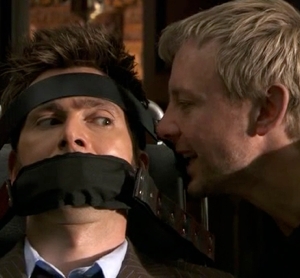
Oh dear! It’s Steven Moffat’s worst story ever! Luckily, as it’s Moffat, it’s still damn good. Just not so awesome that I can drop off a one word review and move on. So; ‘Silence in the Library’ fails to satisfy lazy reviewers. But otherwise…
Well, for a start, it’s a Doctor Who story set inside a library, but it’s not about books. I mean, yes, there’s a bunch of them in it, but their main impact is… well, is unexpected, and not strongly related to their function as reading material.1 As is typical for a Steven Moffat script, it’s actually about quite a few things. Depressingly, it’s refreshing for a Who script to be overflowing with ideas; the scripts this year, ‘Fires of Pompeii’ aside, have been entertaining but uniformly workmanlike, with no more than one fascinating idea per forty-five minutes. The two parts of ‘Library’ average ten times that.
Let’s start with the monsters; because you can’t have the Doctor without the monsters. The Vashta Nerada have the coolest name of any creature in Who for some time, and are also the cheapest you ever did see. Or rather, didn’t see. Luckily, shadows are pretty emotive things, and making them viciously lethal works, generally.2 They get somewhat forgotten in the second part, sadly, and ultimately I felt like they had more potential than they got to display. I mean, we could have had some freaking huge shadows. I’m just saying.
In the second part, the shadows take a back seat to Donna’s own personal Matrix. It’s a particularly effective little story, giving Catherine Tait some interesting emotions to play with, and providing a much more interesting way to explain the plot than having the Doctor draw a circle and point to the middle of it. Though obviously he did that too, for some reason. The real fun here though, was watching characters on television respond to the usual abbreviated narrative conventions of television with surprise. It took me about a week to stop being vaguely amused at all the characters on every other show not noticing their peculiar way of skipping incidental moments in their lives.
And sprinkled all over these elements is the peculiar mystery of Professor River Song, future friend to the Doctor3 and all round good time archaeologist. Despite being played well by Alex Kingston, she isn’t quite as cool as the shadows. For a start, the audience is perhaps just as perturbed as the Doctor that they’re meeting someone out of sequence, and the script’s so busy making the Doctor suspicious and wary of the stranger with the bulky screwdriver that the viewers aren’t likely to really take to her. Hopefully, if she turns up again, we’ll get to actually be introduced to her.
I like Moffat. His plots are solid and his ideas are bountiful. His peculiar aversion to murdering his characters, however, becomes a bit strained here. Frankly, I like a spot of death. ‘Silence in the Library’ has a nice, poignant ending, and then another one, which on first passing feels a bit grotesque.4 Miss Evangelista has a lonely, tragic plot, which is then trivially undone. The hilarious Dr Moon is killed by Cal’s tantrum, but comes back later5 because everything’s so gosh darned happy now. Death just won’t stick in the library.
These minor quibbles aren’t enough to spoil it for me, though. There’s wonderful moments running through the whole story, from the tragedy of Miss Evangelista’s death, to the metatextual humour of Cal grinning at the Doctor’s heroics and hiding her face in fear, to the first time the Doctor’s name is spoken on screen. It’s a joyful ride, and I can’t help but think that Doctor Who’s future is in safe hands.
As long as Steven starts killing people.
- It’s vaguely disappointing to have the Doctor enter a library planet and for the best book he mentions be Monty Python’s Big Red Book. I like to think of his tastes as vaguely eclectic, but, well, his little list at the start is somewhat overly poppy for a man who might have read every book ever written. ↩
- It looks like the production team didn’t quite have the time to keep track of every shadow though. There are those in this world who will automatically start checking whether the characters in a story cross shadows when they’re specifically told not to. These people will find what they’re looking for. ↩
- Or, she tortured him to death with his own screwdriver until he revealed his name. Let’s not rule it out. ↩
- Well, in a way. River’s essentially dead, but gets to live out her afterlife in the same constructed world we were just rooting for Donna to escape from. However, on reflection, she does have access to every book ever written. This is my idea of a good heaven, but what we actually see of it makes her appear like a single mum with three kids for eternity. This is not my idea of a good heaven. As I mentioned before; books in this story appear to be limited to peculiar little objects that get made from trees and then thrown at you. Even Cal, the girl placed inside the library because she loved books so, is continually parked in front of the telly. It’s all a bit disjointed. ↩
- Being a computer program, Dr Moon’s resurrection is of course more understandable, but I list it simply to illustrate the pattern. ↩
Grand Theft Addiction
There’s a reason there’s not many updates around here at the moment, and it goes by the name of Grand Theft Auto IV. I’m finished, yet still not done.
I’m currently considering napalming the whole of Liberty City. The cost in human lives will surely be outweighed by the time I’ll save not running about killing all the pigeons.
Comment [3]
Doctor Who The Unicorn and the Wasp
I liked Agatha Christie a lot as a kid. I enjoyed how readable they were, but even more than that, I enjoyed how the endings always took me by surprise but explained everything. Looking back, I can’t be sure just how logical they were, or whether they were just expertly executed tricks on my young mind, but one thing’s for sure; they made more sense than the last five minutes of ‘The Unicorn and the Wasp’.
Luckily for Gareth Roberts’ second story, there are several more minutes in ‘The Unicorn and the Wasp’, and they’re almost all good. Generally speaking, it’s a funnier script than his ‘Shakespeare Code’ last year, with more interesting characters. The flashback sequence and the attempted poisoning probably rank up there as some of the funniest moments in Who ever. For a long time, the story looks like it might be about to be awesome.
But then, for some reason, a giant wasp turns up. I don’t know why. I’m not sure Gareth Roberts knew why. We’ve got crazy flashbacks. We’ve got ridiculous deaths. We’ve got mysteries and intrigue. Why on earth do we need a CGI monster? If the werewolf in ‘Tooth and Claw’ represented the pinnacle of computer graphics, then the wasp represents its nadir. It never quite looks like it’s really there, not because the effects are particularly substandard, but because you can’t really understand why the hell it’d want to be there in the first place.
And, sadly, the answer to the mystery of “what the fuck is up with that giant wasp” is even more unconvincing than the wasp. After having the balls to be completely and hilariously over the top, ‘The Unicorn and the Wasp’ decides it’s necessary to explain why it’s a murder mystery with Agatha Christie. This puzzled me somewhat. What kind of person wouldn’t accept it? What kind of person wouldn’t expect it? But no, there’s a reason it’s all happening this way, and my goodness, but it’s the most ridiculously convoluted thing you’ve ever heard.
So. Useless giant wasp. Bizarre justifications. If the rest of the episode were average, I’d be condemning it now. But the thing is, the rest of the story is quite awesome. Tennant’s giving some of his best comedic work. Tate’s generally entertaining. Fenella Woolgar is an excellent Agatha Christie.1 Christopher Benjamin is back.2 It even has that wibbly twinkling flashback sound effect. So I’m not condemning. I’m just vaguely irritated at yet another kind of average Doctor Who episode.
- Says the man with no idea what she should look like or be like. But her rather stern relative on Confidential seemed pleased. Whether or not the script should have been quite so insistent on her genius is another matter. I don’t mind it so much, but if Doctor Who meets Dan Brown down the track, and calls him a genius, I might start to get stroppy. ↩
- But with a disappointingly small part. Those who’ve not seen ‘Inferno’ or ‘The Talons of Weng-Chiang’ probably won’t care, but I was surprised how nice it was to see him again. If only Michael Sheard was still alive… ↩
Battlestar Galactica The Road Less Traveled
I don’t think I completely covered the crazies in my previous review. I didn’t want to mention every crazy person — because the fleet is full of nutters — but there are a couple of people who have upped the crazy level this episode.
Leoben Conoy ferverently believes in Kara’s destiny and seems to think that painting is the best way to find Earth. I’ve never thought that predicting the future through paintings was a good idea. It seems so imprecise. There’s very little solid information that can be taken from a painting.1 It’s not a good system. So when Starbuck’s painting away instead of looking at star charts, I start to worry. Is this whole plot going to be wasted by returning to the fleet a little more frazzled than when they left? Aside from the giant dead end of New Caprica, it’s not like BSG to waste episodes going nowhere.
Tory Foster is the craziest of the lot. I thought she’d been calmly accepting her fate and retaining her humanity. Unfortunately she’s acting like how she believes a Cylon should act. Not the squabbly whiney bunch that they actually are but as cool calculating robots. Now she’s walking around offing people and pretending to be super human. She’s going to come to a sticky end.
There’s this fat bald guy with a skipping rope. I don’t know where he’s come from. Looks a bit like the guy from Hitman, but fatter. Oh wait, it’s Chief Tyrol. I really am not good at recognising faces. Anyway Tyrol’s having trouble. He’s found out he’s a Cylon, lost his wife, and has some repressed feelings to deal with. He’s so crazy that he’s being comforted by Gaius Baltar.
Gaius, for a change, seems like the least mad of everyone. He’s on an up swing at this moment in his bizarre life. He’s continued preaching his generic religious beliefs and expanded his harem, cult of nubile young women. Aside from the occasional beatings, his life is sweet.
I love the continued use of the final five theme music with the sitars in it. I’m glad they kept using it. It was far too good to be just used in the last two episodes of season 3.
- Ask Noah Bennet in Heroes when he is trying to prevent his own death. ↩